
Short Answer: Test I+G alongside MSG when the current formula needs a different umami response and already has a defined sensory target. Glutamate and certain nucleotides can interact in umami perception, but a fixed MSG:I+G ratio is not a universal purchasing specification.
Identify the existing glutamate and nucleotide contributors first. MSG, yeast extract, stock ingredients and the food itself may all affect the starting point. Adding a blend without that inventory can duplicate functionality.
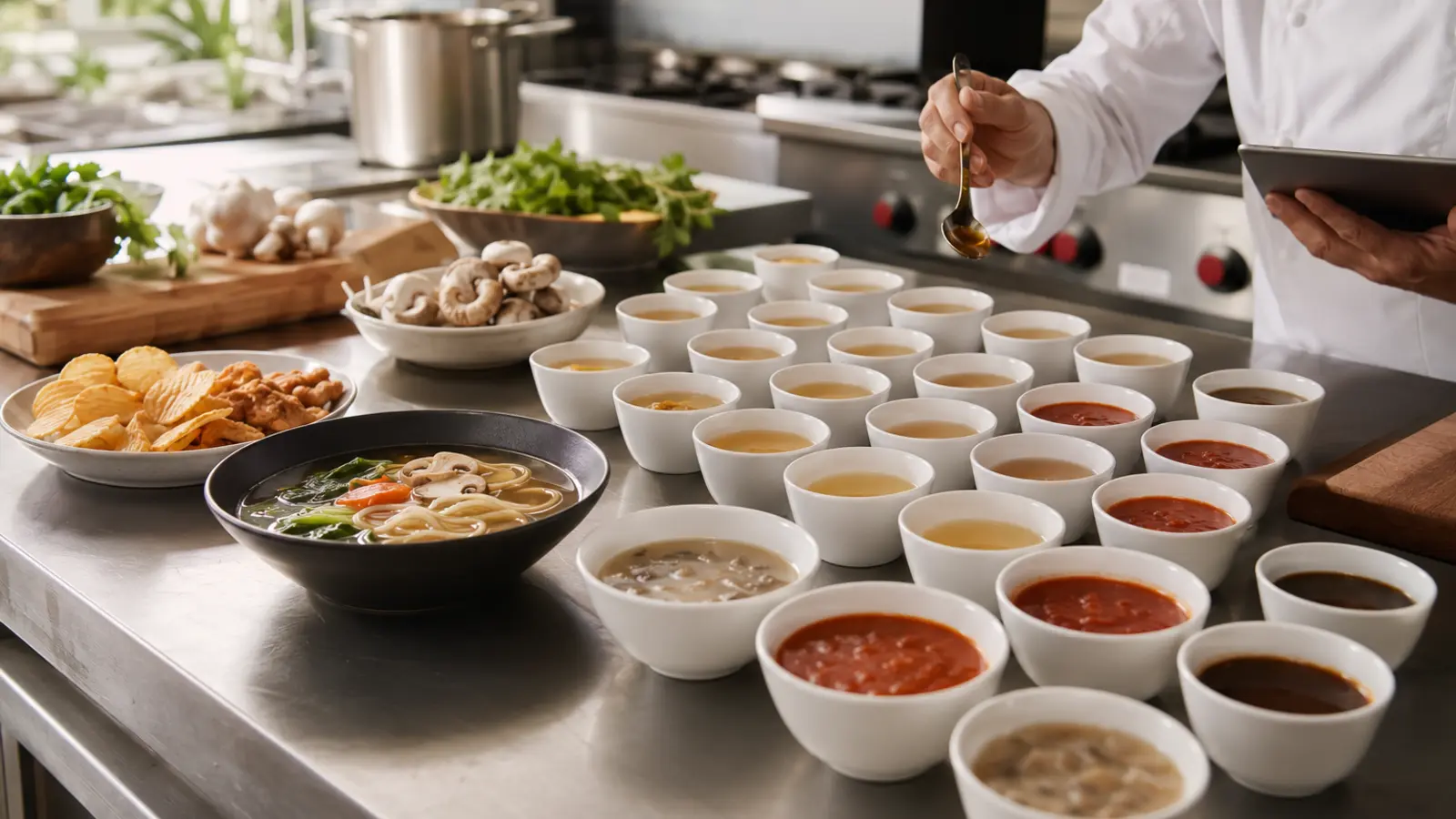
Build a trial that isolates the contribution
Swipe across the table to compare columns.
| Sample | Keep fixed | Question it answers |
|---|---|---|
| Current formula | Recipe and processing | What does the customer currently accept? |
| MSG adjustment | Salt, aroma system and other savory ingredients | Can the target be reached through MSG alone? |
| MSG plus I+G candidate | The same base and evaluation conditions | Does the nucleotide addition produce a useful improvement? |
Evaluate blind in the finished soup, sauce or seasoning application, not only in water. For a dry seasoning, taste at the intended dilution or on the intended food. Record umami intensity, balance, lingering taste and overall acceptability separately.
Choose the candidate that meets the sensory target, then calculate ingredient cost per serving. A more expensive ingredient per kilogram may or may not be economical at the accepted use level. Reject a blend that adds cost without a reproducible benefit.
Read “I+G” beyond the abbreviation
Ask for the declared proportions of disodium inosinate and disodium guanylate, total nucleotide assay, method and moisture basis. Do not assume every disodium ribonucleotide product has the same composition or that a commercial blend is undiluted.
If carriers or other flavor enhancers are present, obtain the full declaration before evaluating labels or comparing use levels. Review production-origin information and any required Halal or Kosher certificate for the actual product and manufacturing site.
For MSG, confirm identity, assay, crystal size and dissolution expectations. Particle differences matter when a dry blend segregates or when a short liquid mixing step leaves residue. Check those handling conditions independently of the sensory comparison.
Turn the winning trial into a repeatable order
Record each sample code and COA, the accepted formula, mixing sequence and evaluation conditions. Agree specifications for both ingredients and retain reference samples. A change in I+G composition should trigger review rather than being hidden behind the same abbreviated product name.
Include pack size, moisture protection, storage requirements and trial versus routine MOQ in the commercial request. Confirm destination-market use and labeling conditions for the selected combination. Browse the savory ingredient category with the trial result in hand so the next quotation describes a reproducible system rather than an undefined “umami blend.”
Testing whether I+G adds value?
Send the current savory base, MSG specification, proposed I+G composition and target sensory change. Include serving dilution and volume so we can discuss comparable sample options.
Discuss an MSG and I+G trial